Opinion Mining
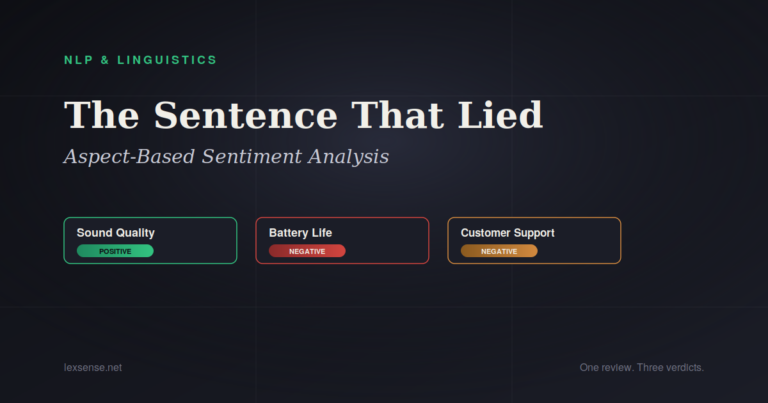
The Sentence That Lied: Aspect-Based Sentiment Analysis
Imagine a customer writes this about a wireless earbud: “The sound quality is incredible, but the battery dies in two hours and…
Read article →
Context & Meaning
Lexsense is a living community for AI researchers, engineers and builders. Share papers, debate methods, learn together and ship better systems.
Explore ideas, exchange knowledge and turn language research into shared practice.
Paper clubs, method debates, reproducibility notes and open questions from the lab.
Explore →Production lessons, evaluation pitfalls, tooling and what actually works in the wild.
Share →Structured pathways, reading lists and short explainers for every level of experience.
Learn →Join a space, contribute an example, respond to a challenge or help improve shared resources.
Contribute →Six starting points for exploring language intelligence, multimodality and applied AI.
Architectures, scaling, alignment, evaluation and practical deployment of LLMs.
Explore area →Language understanding, generation, retrieval, agents and multimodal text systems.
Explore area →Labelling workflows, guidelines and quality for text, image, audio and video datasets.
Explore area →Shared terms, controlled vocabularies and definitions across linguistics, NLP and knowledge work.
Explore area →Structured graphs, ontologies and interoperable data that connect research and systems.
Explore area →Training infrastructure, inference, MLOps, efficiency and production pipelines.
Explore area →Text, image, sound and video can point to the same concept while keeping meaning clear across channels.
Precise terms and definitions for papers, datasets and products.
Open page → ImageImages and diagrams that make concepts easier to distinguish and remember.
Open page → SoundPronunciation and audio support for accessible and audio-first workflows.
Open page → VideoMotion, demonstration and gesture for concepts that need more than a static image.
Open page →The integration of different forms of information—such as text, images, audio and video—within a single system or analysis.
Explore the term →These pages are now editable in WordPress, so their examples and explanations can grow with the project.
Image and sound channels support users who rely on different access modes.
Open page →A shared visual and verbal form cuts mislabelling in annotation and documentation.
Open page →Visual anchors help when translating or aligning terms across languages and domains.
Open page →Explore a space, meet a member and discover a contribution from the community.
Move from reading into discussion, contribution and collaboration.

Discover the people exchanging research, practical knowledge and ideas.
See a contribution connecting transformer research with community discussion.
Four articles selected from the Lexsense blog. Sticky posts are prioritised, otherwise the latest articles appear.
Imagine a customer writes this about a wireless earbud: “The sound quality is incredible, but the battery dies in two hours and…
Read article →Every day, people leave behind an enormous trail of opinion — product reviews, tweets, customer service transcripts, news commentary, forum posts —…
Read article →Why Syntactic Analysis Needs a Common Framework Human languages differ enormously in the way they organize words, phrases, grammatical relations, and meaning.…
Read article →Pick up a chair, and you instantly know what it’s for. Hear the word “justice,” and a cluster of ideas — fairness,…
Read article →A neutral industry reference—not a claim of partnership or endorsement.
Create a free account, join research threads and start the conversation that is missing.
Create free accountGo to Community