
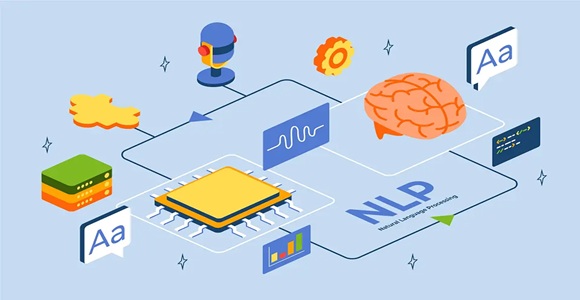
What is Natural Language Processing?
Natural Language Processing (NLP) is a branch of artificial intelligence that enables computers to understand, interpret, and generate human language. In today’s data-driven world, organizations generate massive volumes of text and voice data through emails, social media, chat messages, video transcriptions, and more. NLP tools help businesses analyze this unstructured data, extract actionable insights, detect customer sentiment, and automate communication tasks that power modern AI-driven automation.
Why NLP Matters for Business
NLP technology transforms human communication into measurable business intelligence. Almost every AI tool you interact with, from chatbots to virtual assistants, relies on NLP capabilities. As global data production continues to grow exponentially, natural language processing enables businesses to classify and filter large datasets, understand sentiment and intent in customer interactions, and automate repetitive tasks to improve operational efficiency. By integrating NLP, organizations can leverage data for competitive advantage, enhance customer engagement, and optimize business operations.
The Evolution of NLP
NLP research began in the 1950s with early experiments in machine translation. A significant milestone was the Georgetown-IBM experiment in 1954, which successfully translated 60 Russian sentences into English. During the 1990s and early 2000s, NLP gained popularity through applications like spam filtering, document classification, and basic chatbots. The real turning point came in the 2010s with the rise of deep learning models using neural network architecture to analyze data sequences, making it possible to process larger blocks of text and unlock insights buried in emails, customer feedback, support tickets, and social media posts.
Today, Generative AI has marked another major breakthrough in natural language processing. Modern NLP software can now respond creatively, moving beyond simple processing to sophisticated natural language generation. AI agents with NLP capabilities can summarize meetings, draft emails, translate conversations in real-time, and generate human-like responses that enhance productivity and improve customer experience.
Key NLP Use Cases for Business
Sensitive Data Redaction
Organizations in insurance, legal, and healthcare sectors process large volumes of sensitive documents containing medical records, financial data, and personal information. Instead of manual review, companies use NLP technology to automatically redact personally identifiable information and protect sensitive data. For example, Chisel AI helps insurance carriers extract policy numbers, expiration dates, and customer attributes from unstructured documents using Amazon Comprehend.
Customer Engagement
NLP technologies power chat and voice bots that converse naturally with customers, allowing businesses to scale customer service capability while keeping operational costs minimal. PubNub uses Amazon Comprehend to introduce localized chat functionality for global customers. T-Mobile identifies specific keywords in text messages to offer personalized recommendations, while Oklahoma State University deploys Q&A chatbot solutions to address student questions using machine learning technology.
Business Analytics
Marketers leverage NLP analytics tools like Amazon Comprehend and Amazon Lex to perform sentiment analysis and identify customer emotions in reviews, surveys, and support tickets. By scanning for specific phrases, businesses can gauge customer moods and gain actionable insights. Success KPI provides natural language processing solutions that help contact centers derive meaningful insights from call analytics and focus on targeted areas in sentiment analysis.
How NLP Works
Natural language processing combines computational linguistics, machine learning, and deep learning models to process human language effectively.
Computational Linguistics is the science of understanding and constructing human language models with computers. Researchers use methods like syntactic and semantic analysis to create frameworks that help machines understand conversational language. These frameworks power language translators, text-to-speech synthesizers, and speech recognition software.
Machine Learning and Deep Learning train computers to recognize complex language features like sarcasm, metaphors, sentence structure variations, and grammar exceptions that take humans years to learn. Deep learning uses neural networks structured to resemble the human brain, enabling computers to recognize, classify, and correlate complex patterns in input data.
Generative AI represents the latest advancement, using transformers with self-attention mechanisms that can look at different parts of a sequence simultaneously and determine which parts are most important. This allows models to learn from larger datasets and process very large texts where context from earlier passages influences the meaning of what comes next.
Core NLP Approaches
Organizations implement NLP using different methodological approaches depending on their specific needs:
Supervised NLP trains models with labeled datasets, feeding the software large volumes of known data so it learns to produce correct outputs from unknown inputs. This approach is commonly used for document categorization tasks.
Unsupervised NLP uses statistical language models to predict patterns from non-labeled input. The autocomplete feature in text messaging is a familiar example, suggesting relevant words by monitoring user response patterns.
Natural Language Understanding (NLU) focuses on analyzing the meaning behind sentences, allowing software to find similar meanings in different sentences or process words with multiple meanings based on context.
Natural Language Generation (NLG) focuses on producing conversational text based on specific keywords or topics, enabling intelligent chatbots to converse with customers similarly to human support personnel.
Essential NLP Tasks
NLP techniques break down human text and speech into components that computer programs can process:
Part-of-Speech Tagging identifies words as nouns, verbs, adjectives, or adverbs according to contextual usage, helping computers understand how words form meaningful relationships.
Word-Sense Disambiguation determines a word’s intended meaning when it has multiple definitions. For instance, NLP distinguishes whether “bat” refers to the nocturnal creature or sports equipment based on sentence context.
Speech Recognition converts voice data into text by breaking words into smaller parts and understanding accents, intonation, and nonstandard grammar in everyday conversation. Services like Amazon Transcribe enable accurate transcription capabilities.
Machine Translation converts text or speech from one language to another while retaining contextual accuracy, powered by services like Amazon Translate.
Named-Entity Recognition identifies unique names for people, places, events, and companies, then determines relationships between different entities in a sentence. Co-reference resolution extends this by determining if different words describe the same entity.
Sentiment Analysis interprets emotions conveyed by textual data, analyzing text for words and phrases that show dissatisfaction, happiness, doubt, regret, and other hidden emotions.
Implementation Process
NLP implementation typically begins by gathering unstructured text or speech data from sources like cloud data warehouses, surveys, emails, or business applications. The data undergoes pre-processing techniques including tokenization (breaking sentences into individual words or phrases), stemming and lemmatization (simplifying words to their root form), and stop word removal (eliminating words that don’t add significant meaning).
Researchers then use pre-processed data and machine learning to train NLP models for specific applications based on the provided textual information. Training requires feeding the software large data samples to increase algorithm accuracy. Finally, experts deploy the model into production environments where it receives input and predicts outputs for its designed use case, running on live data to obtain required results.
Transform Your Business with NLP
Natural language processing has become a cornerstone of AI-driven automation, enabling organizations to turn vast amounts of communication data into competitive advantages. Whether you’re looking to automate customer service, extract insights from unstructured data, or enhance business intelligence, NLP provides the tools to make human language accessible and actionable for your organization.
How can AWS help with your NLP tasks?
AWS provides the broadest and most complete set of artificial intelligence services for customers of all levels of expertise. These services are connected to a comprehensive set of data sources.
- Lexsense Annotates focus on semantic annotation and AI training data preparation
- Lexsense Lexicon builds structured vocabulary and metadata tailored to a specific context.
- Lexsense Transcribe It enables conversion of spoken language (audio) into written text
- Lexsense Converts text from one language to another while preserving meaning, context, and intent
- Lexsense Imago does an intelligent search of enterprise systems to quickly find the content one is looking for
Get started with NLP by creating an Lexsense account today.
