
 Written by
 A Room Full of Different Minds
Ask a room full of people to solve the same puzzle, and you’ll get a room full of different experiences. One person will blurt out the answer in ten seconds. Another will get there in three minutes, but never make a single wrong turn along the way. A third will draw a diagram. A fourth will talk it through out loud. All of them might land on the correct answer — yet no two of them will have thought about it in quite the same way.
This isn’t a quirky observation about puzzle-solving. It’s a window into one of the most well-established facts in psychology and neuroscience: human minds, despite sharing the same basic architecture, operate in remarkably different ways. Memory, attention, language, perception, processing speed, decision-making — every one of these functions varies from person to person, sometimes dramatically. The question “do cognitive functions vary among individuals?” isn’t really up for debate. Decades of research answer it with an unambiguous yes. What’s far more interesting is how they vary, why, and what that means for the way we teach, hire, diagnose, and simply live alongside one another.
The Same Toolkit, Used Differently
Cognitive scientists typically break the mind’s work into a handful of core functions: attention, memory, executive function (planning, inhibition, flexible thinking, decision-making), language, perception, and processing speed. Every healthy brain has all of these tools in its kit. But having the same toolkit doesn’t mean using it the same way.
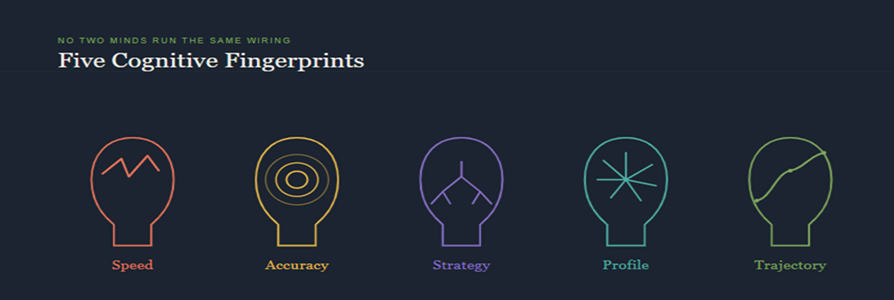
Variation shows up along several distinct dimensions, and it’s worth pulling them apart because they tell different stories.
Speed
Some people process information fast — quick reaction times, rapid reading comprehension, snap decision-making. Others are slower but no less capable; they simply take a more deliberate route to the same destination. Processing speed differences show up in everything from how quickly someone reacts behind the wheel to how efficiently they work through a dense report.
Accuracy
Speed and accuracy don’t always travel together. Someone might race through a task and still make fewer errors than a more cautious peer — or the opposite. Precision in reasoning, attention, and judgment is its own axis of difference, independent of raw speed.
Strategy
Even when two people reach identical outcomes, they may have taken entirely different mental paths to get there. Some lean on visual thinking, picturing problems as diagrams or spatial layouts. Others process best through language, talking or writing their way to clarity. Some default to rules and structured logic; others trust intuition and pattern recognition. Neither approach is inherently superior — they’re simply different operating systems running on the same hardware.
Profile
Perhaps the most important — and most underappreciated — form of variation is the profile of strengths and weaknesses each person carries. Very few people are uniformly strong or weak across the board. It’s far more common to find someone with exceptional spatial reasoning who struggles with working memory, or someone with a razor-sharp memory for faces and names but real difficulty with abstract, symbolic thinking. A single IQ score flattens all of this nuance into one number. A cognitive profile — a map of relative strengths and weaknesses — tells you far more about how a person actually thinks, learns, and solves problems.
Trajectory
Cognition isn’t static, and it doesn’t develop or decline on a single universal timeline. Some children hit language milestones early and mathematical reasoning late, or vice versa. In adulthood, cognitive abilities often peak at different ages — crystallized knowledge like vocabulary can keep improving well into your 60s, while raw processing speed tends to peak much earlier. And as people age, the rate and pattern of cognitive decline varies enormously: some individuals stay remarkably sharp well into their 80s, while others experience earlier or steeper decline. There is no single aging curve that applies to everyone.
Where the Differences Come From
If cognitive variation were purely random noise, it wouldn’t be nearly as interesting. But it isn’t random — it emerges from a tangle of interacting causes, and untangling them is one of the great ongoing projects of neuroscience and psychology.
Genetics lays down a meaningful part of the foundation. Twin and family studies consistently show that a substantial portion of variance in traits like working memory capacity or processing speed tracks with genetic relatedness. But genes don’t operate in isolation — they interact with everything else on this list, often in ways researchers are still working out.
Neurobiology adds another layer. Brains differ in structure and function in ways that matter cognitively: variation in gray matter density in specific regions, differences in white matter connectivity between brain areas, and differences in how efficiently neural networks communicate. These aren’t abstractions — they’re measurable physical differences that correlate with measurable cognitive ones.
Development matters too. The brain doesn’t arrive fully formed; it’s sculpted over years through maturation, pruning, and myelination, and the pace and pattern of that sculpting differs from child to child, shaping the cognitive profile that eventually emerges.
Then there’s environment — arguably the most actionable piece of the puzzle. Education, nutrition, sleep, stress, socioeconomic conditions, and cultural context all leave fingerprints on cognitive development. A child in a language-rich environment tends to develop stronger verbal skills. Chronic stress or poor nutrition can measurably suppress executive function. Culture even shapes how people think — some cultural contexts encourage more holistic, context-dependent reasoning, while others favor analytic, rule-based reasoning.
Finally, individual experience — the countless hours of practice, exposure, and lived history unique to each person — fine-tunes the whole system. A professional musician’s auditory processing looks different from a non-musician’s. A chess grandmaster’s pattern recognition for board positions outstrips almost anyone else’s, not because of some innate gift alone, but because of thousands of hours spent building that specific capacity.
Why This Actually Matters
None of this is academic trivia. Recognizing that cognitive functions vary — genuinely, meaningfully, and along multiple independent dimensions — has real consequences.
In education, it means a one-size-fits-all curriculum inevitably underserves a large share of students. Understanding that some learners are visual, some verbal, some fast, some deliberate, opens the door to more flexible, more effective teaching.
In the workplace, it means that raw intelligence is a poor proxy for job performance, and that diverse cognitive profiles on a team — some people strong in rapid execution, others in careful analysis, others in creative reframing — often outperform a team of cognitive clones.
In clinical practice, understanding the normal range of cognitive variation is essential for distinguishing ordinary difference from genuine impairment, and for tailoring interventions to an individual’s actual profile rather than a generic template.
And in everyday social interaction, simply knowing that other minds don’t run the same software you do fosters patience, better communication, and less frustration when someone else doesn’t “get it” as quickly — or gets it faster, but differently — than you do.
Conclusion
The human mind is not one thing repeated eight billion times. It’s a shared architecture expressed through an extraordinary range of individual variation — in speed, accuracy, strategy, strengths, and trajectory. No single test score, learning style, or personality type captures the full shape of how a person thinks; the real picture only emerges when you look at all five dimensions together.
That’s not a limitation of the science — it’s the finding. Cognitive diversity isn’t noise to be averaged away; it’s the reason a classroom, a team, or a family works better with a mix of thinkers than with a room full of cognitive clones. Accepting that fully, rather than treating it as an inconvenient footnote, is the first step toward building schools, workplaces, and relationships that actually work with the minds people really have — not the idealized, uniform mind that textbooks sometimes imply.