
 Written by
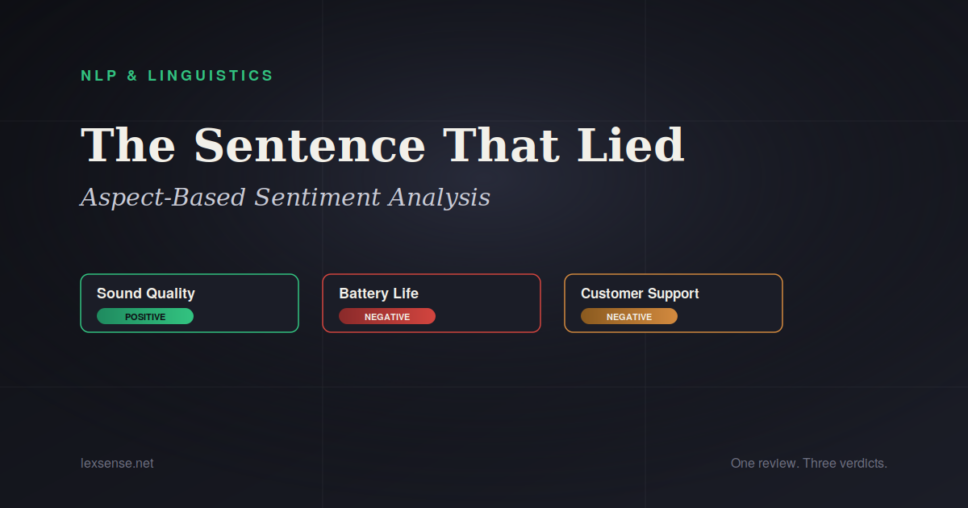
 Imagine a customer writes this about a wireless earbud: “The sound quality is incredible, but the battery dies in two hours and customer support never answered my emails.”
Now imagine you’re the product manager reading a dashboard that scores this review as “Positive.” You’d be wrong to trust it — and worse, you’d never know why. This is the exact failure that aspect-based sentiment analysis (ABSA) was built to fix, and understanding it changes how you think about every star rating, every review aggregator, and every “customer sentiment” report you’ve ever glanced at and believed.
The Problem With Asking “Is This Positive or Negative?”
Traditional sentiment analysis treats a sentence — or a whole review — as a single emotional unit. It runs the text through a classifier and returns one verdict: positive, negative, or neutral. That works fine for something like “I love this phone.” It falls apart the moment a person says something even slightly more human, which is to say almost always.
Real opinions are rarely clean. People love the camera and hate the price. They praise the staff and complain about the wait. A single sentiment score forces all of that into one number, and in doing so throws away the most useful information in the entire review.
That earbud review isn’t one opinion — it’s three. A strongly positive opinion about sound quality. A strongly negative opinion about battery life. A negative opinion about customer support. A document-level model might average these into a bland “neutral,” or worse, latch onto the enthusiastic opening and call the whole thing “positive.” Either way, the business loses the signal that actually matters: sound is a strength, battery is a liability, and support is broken.
What ABSA Actually Does
ABSA works in two coordinated steps.
Step one: aspect extraction. The system identifies the specific features, attributes, or entities under discussion — “sound quality,” “battery,” “customer support” in our example. These are the aspects. Depending on the system’s sophistication, they might be pulled out through rule-based part-of-speech patterns — nouns sitting near opinion-bearing adjectives — through statistical topic modeling, or increasingly through transformer-based models fine-tuned on domain-specific features, whether that’s “legroom” in an airline review or “acting” in a film review.
Step two: aspect-level sentiment classification. Once the aspects are identified, the model determines the sentiment polarity attached to each one individually rather than to the text as a whole. It does this by examining the local context around each aspect term — the adjectives, intensifiers, and negations clustered near it — and, in neural models, by using attention mechanisms that literally learn which words in a sentence belong to which aspect.
Run the earbud sentence through a proper ABSA pipeline and you get something structured and genuinely actionable:
- Sound quality → Positive (confidence: high)
- Battery life → Negative (confidence: high)
- Customer support → Negative (confidence: moderate)
One messy sentence becomes three clean, separate data points. That’s the entire trick — and it’s bigger than it first appears.
A Second, Trickier Example
Consider a restaurant review: “The pasta was bland and overpriced, but honestly, the ambiance made up for it, and our server was an absolute gem.”
A document-level model, weighing three positive-leaning clauses against one negative-leaning one, would likely call this “positive.” Technically defensible, practically useless if you’re the head chef wondering why pasta orders keep declining. ABSA breaks it apart correctly:
- Food (pasta) → Negative
- Price → Negative
- Ambiance → Positive
- Service → Positive
Now the chef has an unambiguous mandate: fix the pasta and reconsider the pricing, because two of four dimensions of the dining experience are actively driving customers away — no matter how charming the server was.
Why This Level of Granularity Matters
The advantage of ABSA over ordinary sentiment analysis isn’t just academic precision — it’s the difference between a metric and a diagnosis. A single sentiment score tells you that something is wrong; aspect-based analysis tells you what.
In product development, ABSA lets teams see exactly which features are winning and which are bleeding customers, without anyone reading thousands of reviews by hand. A software company might discover that users adore the new interface but are enraged by sync bugs — two contradictory signals a blended sentiment score would have muddied into forgettable mediocrity. In hospitality, it separates complaints about cleanliness from complaints about noise from praise for location, letting a hotel chain fix the right problem instead of guessing. In political and social listening, it distinguishes sentiment toward a candidate’s policy positions from sentiment toward their communication style — two things that are often wildly different and easily conflated.
There’s a compounding advantage too: aspect-level data aggregates beautifully. Once ten thousand reviews are broken into aspect-sentiment pairs, you can chart trends over time for each attribute — did “battery life” sentiment improve after last quarter’s firmware update? You can compare products head-to-head on individual dimensions instead of overall star ratings, which flatten meaningful differences. And you can feed the structured output directly into dashboards, alerting systems, or automated triage queues — something a single fuzzy sentiment label simply can’t support.
From Signal to Decision
This is where ABSA earns its keep as a genuine decision-making tool rather than an analytics curiosity. Suppose an electronics retailer runs ABSA across twelve thousand reviews of a wireless earbud model before deciding whether to reorder inventory for the holiday season. The output might reveal: sound quality sentiment 91% positive, comfort sentiment 88% positive, battery life sentiment 34% positive, customer support sentiment 22% positive.
That’s not ambiguous data anymore — it’s a decision framework. The retailer can reasonably conclude: the core product experience is strong enough to justify continuing the relationship with this supplier, but the battery and support issues are significant enough to warrant either negotiating a firmware fix and improved support SLAs before reordering, or clearly flagging battery life as a known limitation in product listings to manage expectations and reduce returns. Without aspect-level granularity, the retailer is stuck averaging everything into a single “78% positive” figure — technically accurate, strategically useless, and blind to the specific lever that would actually move the needle.
The Deeper Point
What aspect-based sentiment analysis really represents is a shift from treating opinions as monolithic to treating them as compositional — built from parts, each of which deserves its own hearing. Human beings rarely feel one uncomplicated thing about anything they’ve paid money for. We are, almost by nature, aspect-based creatures: capable of loving a car’s engine and despising its infotainment system in the same breath, without contradiction. The technology finally catching up to that basic truth about how people talk isn’t just a clever engineering trick. It’s a more honest way of listening.
Aspect-Sentiment Breakdown: The Earbud Review

